Week
of November 28, 2004
Fantastic
Apples
Apples
are a rich source of dietary fiber and are rich
in calcium, vitamin A, and vitamin C. Other nutrients
in apples benefit the circulatory and lymphatic
systems. The health benefits of apples have been
touted for centuries and gave rise to the old
adage that "an apple a day keeps the doctor
away." In fact, apples are filled with many
phytonutrients, which are strong natural antioxidants.
Try
this easy and tasty fruit salad for any winter
meal.
Winter
Apple Salad
Serves 4
4
tart green apples, cored and chopped
1/4 cup blanched slivered almonds, toasted
1/4 cup dried cranberries
1/4 cup chopped dried cherries
1 - 8 ounce container low fat vanilla yogurt
In
a medium bowl, stir together the apples, almonds,
cranberries, cherries and yogurt until evenly
coated.
Per
Serving: 181 Calories; 6g Fat (27.7% calories
from fat); 1g Saturated Fat; 5g Protein; 29g Carbohydrate;
4g Dietary Fiber; 3mg Cholesterol; 45mg Sodium.
Exchanges: 0 Grain(Starch); 0 Lean Meat; 1 1/2
Fruit; 1/2 Non-Fat Milk; 1 Fat.
Week
of November 21, 2004
Wonderful
Winter Squash
We
all know about zucchini and yellow summer squash,
but many of us are bewildered by the many and
varied bright green, orange and yellow varieties
of winter squash. In fact, they were once a very
important part of the Native American diet in
North America.
Once
you get past the tough exterior to the mellow,
sweet heart of a winter squash, you will be glad
you tried them. When cooked, the orange or yellow
flesh becomes soft and tastes wonderful in both
savory and sweet dishes.
Always select squash that's heavy for its size
and has a dull rind which tell you that the fruit
is ripe and flavorful. Store winter squash in
a cool, dry place.
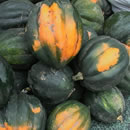
Acorn squash is probably the best squash to just
bake and eat. Its flesh is golden yellow, dry,
and sweet, with a definable but pleasant texture.
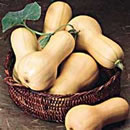
Butternut squash is very versatile and easy to
handle. Its orange flesh is thick, dry, fine-grained,
and sweet. Because of its density and ease of
preparation, butternut is the squash to use when
you want to dice or slice or present squash in
any form other than a purée or a roasted
chunk.
Hubbard squash is often sold in pieces because
it can grow to cumbersome sizes. This squash usually
has a gray-blue shell, with a fine-grained flesh
that's dry, somewhat mealy, and very flavorful
and often used for pies. It's a good-size squash
with tan skin, thick, deep-orange flesh, a coarse
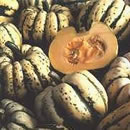
texture, and a really sweet flavor. Sweet dumplings
are tiny but great for roasting and presenting
whole. Sugar pumpkins are good for pies, too,
as well as for canning since they have a thick,
fine-grained flesh.
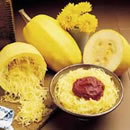
A spaghetti squash is always cooked whole. You
can cook a whole spaghetti squash by either baking,
boiling, or microwaving. Once the squash is cooked,
and is cool enough to handle, halve the squash
and scoop out the seeds and fibers. Then take
a fork and begin to scrape at the squash flesh.
As you tease it apart, the flesh will separate
into pasta like strands which can be tossed with
a low fat Italian sauce.
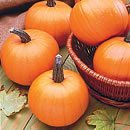
Stay
away from pumpkin pumpkins, whether they're the
classic field type or the original French variety.
Carve them, but don't eat them: they're tough
and bland.
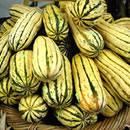
Butternut and delicata squash have a skin that
is fairly easy to peel when raw. For most other
varieties, it is almost impossible to get the
peel off of them while raw. It is best to just
cut them in half, quarters or rings and bake them
at about 375 degrees F. The peel is easily removed
after it is cooked. For squash puree, let it cook
until the flesh is really soft, then scoop it
out of the shell and run it through the food processor.
Roasted Winter Squash
Serves
4
1/4
cup liquid honey
2 tablespoons soy sauce
1 clove garlic, minced
1/4 teaspoon salt
1/4 teaspoon pepper
2 acorn squash (2 ¼ - ½ pounds total)*
Whisk
first 5 ingredients together in a large bowl.
Halve each squash crosswise, and scoop out seeds.
Cut into 1 inch thick rings & toss in honey
mixture until well coated. You can cover and refrigerate
for up to 6 hours at this point if you are preparing
ahead of time
Arrange
squash rings on a greased, foil lined, rimmed
baking sheet and drizzle with honey mixture. Bake
in preheated 400 degrees F oven, turning once
and basting with liquid, until tender and golden,
about 30 to 40 minutes.
*Or
you may use 1 butternut squash, peeled (leave
the peel on acorn and peel butternut - peel can
be removed after cooking on acorn squash)
Per
Serving: 148 Calories; trace Fat (1.1% calories
from fat); trace Saturated Fat; 2g Protein; 39g
Carbohydrate; 3g Dietary Fiber; 0mg Cholesterol;
440mg Sodium. Exchanges: 1 1/2 Grain (Starch);
0 Vegetable; 0 Fat; 1 Other Carbohydrates.
Week
of November 14, 2004
Let's
Talk Turkey
Use
a little common sense when selecting your holiday
turkey. Some companies add fatty agents into their
turkeys to make them what is called self basting.
Indeed, these turkeys require less attention and
basting during the cooking process, but they always
contain more fat than a non self basting turkey.
Buy a lean whole turkey or breast of turkey that
is not self basting.
Use
seasoning instead of stuffing in the turkey cavity,
to enhance the flavor of the meat. You may use
citrus fruits and herbs such as sage, marjoram,
rosemary or thyme. To season the exterior of the
bird, spray or rub it with olive oil and rub with
herbs and citrus juices. Or you may add herbs
or seasoning under the skin of the turkey.
Baste
the turkey by brushing low fat broths or juices
like apple, cranberry and orange juice. Bake the
turkey on a rack with a pan underneath to keep
the turkey from cooking in the collected fat as
it drips.
Bake
the stuffing in a casserole or baking dish rather
than in the cavity of the turkey. When you bake
dressing in the cavity, it soaks up the fat as
the turkey roasts.
Week
of November 7, 2004
It's
that wonderful time of year again - turning leaves,
cold windy fronts, football games, family and
friends and of course turkey leftovers. The question
in a couple of weeks will be what can you do with
those turkey leftovers besides eating one more
turkey sandwich?
Turkey
leftovers are fantastic. Plan the size of the
turkey you buy, based on how much you want left
over. Use leftover turkey in a few meals after
the main meal, but also dice or shred some of
the meat to store in one and two cup freezer containers
or zip lock freezer bags for an easy addition
to meals that you prepare during the busy work
week. Skillet stir fries, casseroles, and shredded
meat sandwiches become a quick and easy meal with
leftover turkey. Don't forget to freeze the carcass
if you don't intend to use it for soup right away.