Week
of July 24, 2005
Like
cabbage, to which it is related, the turnip has
long been thought of as "plain folks"
food. It is economical; it grows well in poor
soil; it keeps well; and it supplies complex carbohydrates.
It is grown for its root vegetable as well as
for its greens, which are rich in vitamins and
minerals. And they are "really low"
in calories!
Turnips/1
cup cubes, boiled
Calories 33
Total fat (g) 0.1
Saturated fat (g) 0
Monounsaturated fat (g) 0
Polyunsaturated fat (g) 0.1
Dietary fiber (g) 3.1
Protein (g) 1
Carbohydrate (g) 8
Cholesterol (mg) 0
Sodium (mg) 78
Vitamin C (mg) 18 |
The
turnips you'll find in the supermarket may range
from roughly the size of a golf ball to that of
a baseball. More or less smoothly spherical or
top-shaped, the most common varieties have a creamy
white skin that shades to purple or reddish pink
or green at the top. Other turnip varieties, however,
are completely white from top to tip.
Newly
harvested turnips are sometimes sold in bunches
with their leaves; these should be crisp and green.
If in good condition, the leaves can be cooked
and eaten. Topped turnips (with the greens cut
off) are frequently sold in plastic bags. Leaf
scars at the stem end of topped turnips should
be few. The turnips themselves should always be
firm and heavy for their size, with a minimum
of fibrous root hairs at the bottom. Their surface
should be smooth, not shriveled or bruised.
Small
turnips, around 2 to 2 1/2 inches, have the best
flavor and texture.
Young small turnips can be eaten raw, but larger
more mature ones may be strongly flavored. You
can lessen the stronger taste somewhat by blanching
them in boiling water for about five minutes before
baking, braising, or stir-frying. To keep the
flavor mild, don't overcook these vegetables.
Raw:
Serve young raw turnips in salads, slaws or sliced
and served with your favorite dips along with
other vegetables like carrots, celery and green
peppers.
Baking/Roasting:
Place 1/4"-thick slices of turnip in a shallow
baking dish and sprinkle with a few tablespoons
of water. Cover and bake in a 350°F oven until
tender. Quartered turnips can be roasted alongside
meat or poultry. Cooking times: for turnips, 30
to 45 minutes; for rutabagas, 50 to 60 minutes.
Boiling:
Drop whole turnips into a pot of boiling water,
cover, and cook just until tender. Uncover the
pot occasionally during cooking to allow the gases
to escape and to ensure a delicate flavor. If
a little sugar is added to the water, it will
sweeten the taste of either vegetable. Cook thick
slices of turnip in a skillet with 1" of
boiling water; blanch julienne turnips in boiling
water for just one to two minutes. Cooking times:
for whole turnips, 20 to 30 minutes; for sliced
or diced turnips, six to eight minutes.
Braising:
Place sliced or cubed turnips in a heavy skillet.
Add enough broth to cover the bottom of the pan,
cover, and simmer until tender. Cooking time:
10 to 12 minutes.
Microwaving:
Place a pound of cubed turnips in a microwaveable
baking dish, add 3 tablespoons of liquid, cover,
and cook until tender. Stir halfway through cooking
time; let stand three minutes after removing them
from the microwave. Cooking time: seven to nine
minutes.
Steaming:
Whole or cut-up turnips can be steamed over boiling
water, then cooked until just tender. Cooking
times: for whole medium-size turnips, 20 to 25
minutes; for cut-up turnips, 12 to 15 minutes.
Stir-frying:
Stir-fry thinly sliced turnips until they are
crisp-tender. Cooking time: six to seven minutes.
Week
of July 17, 2005
While
you have the grilled fired up, don't forget the
vegetables. Grilling vegetables is not only easy
but they are extremely flavorful. The secret is
to cut the vegetables into pieces that will cook
quickly and evenly. Make sure that pieces are
not more than 3/4 to 1 inch thick and are of a
uniform and same thickness. Give veggies a bath
in cold water for about 30 minutes before grilling
to keep moist. Pat dry, then brush or spray lightly
with oil to prevent sticking. If you want to add
spices or herbs, you can dramatically change the
flavor. One of my favorite blends to add is garlic
salt, red pepper, basil and a little brown sugar.
Do not over cook. For grilling vegetables that
are smaller, use a grilling basket to keep them
out of the fire.
| Vegetable/Fruit |
Preparation |
Grilling
Instructions |
| Asparagus |
Cut
off ends. Soak in water for 30 minutes to
an hour. Pat dry and brush with olive oil.
|
Place
on grill, turning every minute. |
| Chili
Peppers |
Brush
with oil. |
Grill
whole on each side, 2-3 minutes. To reduce
the heat, cut off the stems and pull out the
seeds. |
| Corn
on
the
Cob |
Gently
pull back the husks but don't remove. Remove
the silk and cut off the very end. Soak in
cold water for about 30 minutes. Dry and brush
with butter. Fold the husks back down and
tie or twist the ends. |
Place
on grill for about 5 to 7 minutes. Turn to
avoid burning. |
| Eggplant |
Cut
lengthwise for smaller eggplants or in disks
top to bottom for larger eggplants. Soak in
water for 30 minutes. Pat dry, brush with
oil. |
Grill
2-3 minutes. |
| Garlic |
Take
whole bulbs and cut off the root end. Brush
with olive oil. |
Place
cut side down over a hit fire. Grill garlic
bulbs for about 10 minutes or until the skin
is brown. |
| Mushrooms |
Rinse
off dirt and pat dry. Brush with oil. |
Grill
4-5 minutes for small mushrooms, 6-8 minutes.
Use a grill basket or topper for small mushrooms. |
| Onions |
Remove
skin and cut horizontally about 1/2 inch thick.
Brush with oil |
Grill 3-4 minutes. |
| Tomatoes |
Cut
in half, top to bottom. |
Grill
cut side down 2-3 minutes. |
| Potatoes |
Wash
thoroughly and dry. Rub with oil. Wrap in
aluminum foil. |
Grill
35-40 minutes, turning occasionally. |
| Zucchini
and
Summer Squash |
Slice
1/2 inch thickness. Brush with oil. |
Grill
2-3 minutes per side. Small squash can be
cut down the middle and grilling in halves.
|
Week
of July 10, 2005
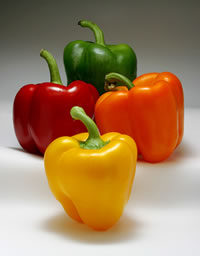
Bell
peppers can add brilliant color, exceptional flavor
and vitamins and nutrients to your summer entrees,
side dishes and salads. Whether green, yellow,
orange or red, bell peppers complement almost
any meal.
Bell
peppers in favorite recipes adds very little fat,
no cholesterol and no sodium. Bell peppers are
also an excellent source of vitamin C.
Nutritional analysis of one medium bell pepper:
Calories - 25; Protein - 1g; Cholesterol - 0g;
Sodium - 0g; Carbohydrates - 5g; Dietary Fiber
- 2g; Fat - 1g
When buying sweet bell peppers, you should look
for peppers that are firm and well-shaped with
uniform, glossy color and thick walls.
Soft watery spots found on the sides of bell peppers
indicate decay. Avoid bell peppers with pale skin
and soft, pliable flesh, which indicates immaturity.
Store bell peppers in the refrigerator crisper,
and they will stay fresh for up to two weeks.
When cooking with bell peppers, remove the seeds
before serving.
Week
of July 03, 2005
Glorious
In Season Local Tomatoes
Real
old fashion beefsteak tomato. are tomatoes without
a center core, all tomato inside, no white hard
core in the middle. Sometimes called "ugly
ripes", they are often misshaped with cracks
coming from the stem end making them ugly to look
at, but delicious to eat.
A real good tomato is sweet, tender and juicy
with a deep rich red color. The key to getting
a great tasting tomato is maturity. The longer
on the plant the riper the tomato is, the better
the taste. Most tomatoes are picked green and
shipped in refrigerated trucks because they are
highly perishable. Tomatoes will continue to ripen
once picked but they will not get any tastier,
(sweet or juicy).
Scientists
and marketers got together and developed different
hybrids of the old good tasting tomato, the beefsteak,
to produce a tomato that could be shipped from
one coast to the other without bruising. They
succeeded, but regrettably, they also bred out
all the flavor. Tomatoes today look great, are
hard and don't have any flavor.
A
great tomato is worth scouting out. A good place
to find them are at local farm to market stands.
Grab several pounds and bring them home. Just
remember NOT TO REFRIGERATE!
Refrigerating
kills the flavor, the nutrients, the texture.
Tomatoes ripen from inside out with the center
of the tomato always riper than the skin. The
ideal temperature for tomatoes is somewhere between
55 to 70 degrees F. At this temperature the tomato
will ripen inside and out. The tomato will have
a full flavor and stay moist and plump and slice
better.
Heat
makes them mushy and flavorless and speeds up
decay. Never ripen tomatoes in direct sunlight.
Just keep on counter, stem up to keep from bruising.
A
ripe tomato will be soft - but not squishy.
One
of my favorite summer treats is to cut up big,
juicy, thick slices of fresh local tomatoes and
place on fresh homemade bread with thin slices
of red onions, olive oil, balsamic vinegar and
a sprinkle of dried oregano or a few chopped fresh
basil leaves and a little salt and pepper. THIS
IS REAL FLAVOR!!!